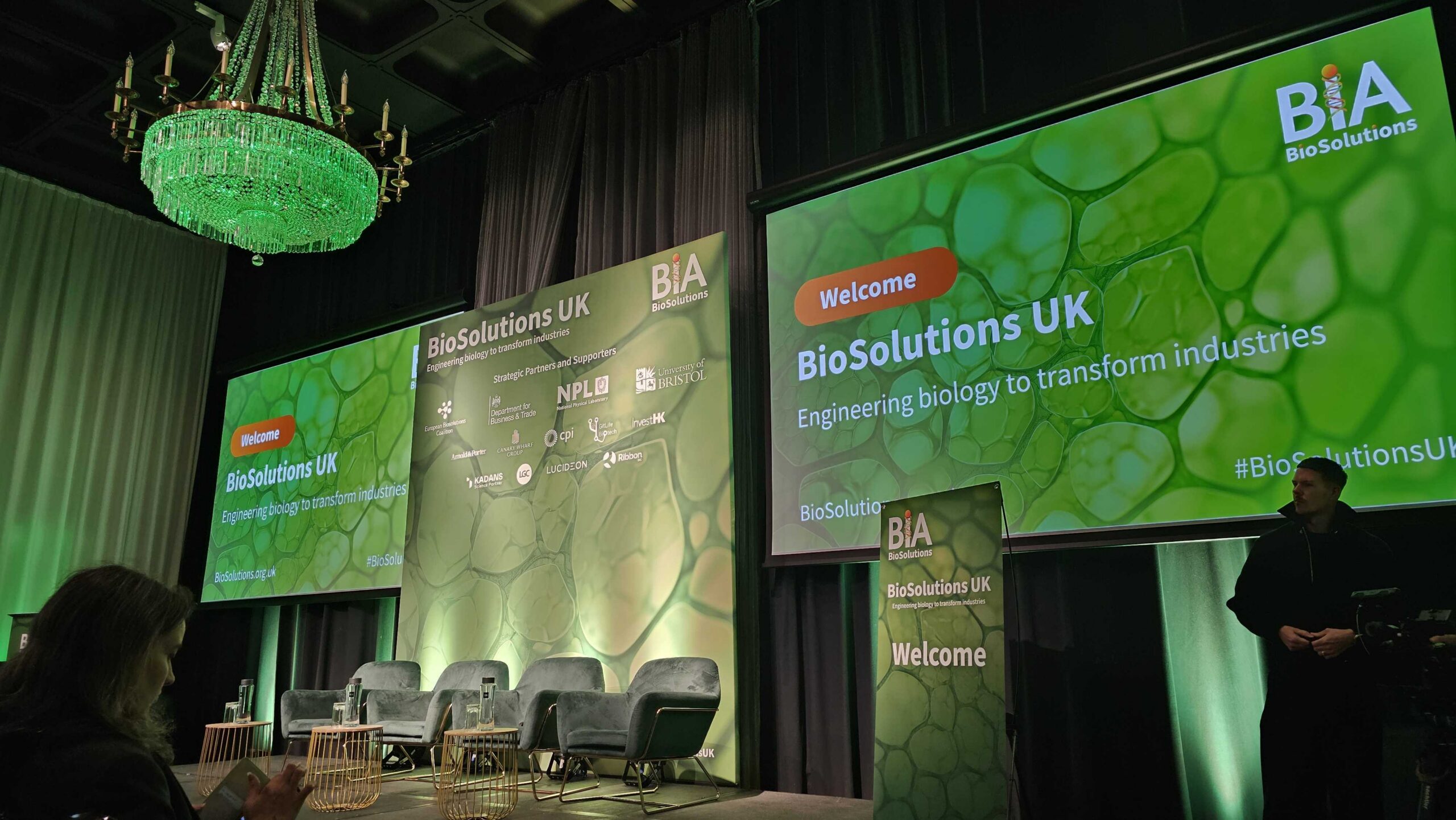
Satnam Surae, CTO and Co-founder of twig, attended BioSolutions UK this week, held at the impressive Glaziers Hall in central London. The atmosphere was engaged and pragmatic, bringing together a diverse mix of startups, investors, corporates, and established players across the engineering biology ecosystem.
A central theme that emerged from discussions was the increasing influence of geopolitics on engineering biology. Post-Brexit realities, rising competition from Asia, and evolving dynamics with the United States are collectively driving a closer alignment between the UK and Europe. For companies operating in this space, EU partnerships are quickly becoming essential for scaling and commercialisation. This is already reflected in practice, including twig’s own collaboration with a German CDMO, and signals a broader shift towards more integrated, cross-border strategies.
The presence of Chris McDonald MP and George Freeman MP at the event underscored the level of political support behind the sector. Engineering biology is now positioned as one of the UK’s five core pillars within the industrial strategy, with further funding and policy initiatives expected. There is also growing recognition that regulatory agility could provide the UK with a competitive advantage relative to the EU. However, challenges remain – particularly in later-stage investment, energy policy, fermentation capacity, and downstream processing infrastructure, and exit opportunities – which will ultimately determine how effectively the UK can translate ambition into scaled deployment.
From a commercial perspective, the industry is clearly maturing. Large corporates are increasingly focused on engaging with startups that can offer well-defined, de-risked biosolutions, rather than broad or exploratory capabilities. This shift is reflected in structured engagement models, including corporate venture initiatives such as L’Oréal’s BOLD fund, innovation portals from companies like Pladis, and startup programmes such as Syngenta’s Shoots initiative. These frameworks signal a move towards more outcome-driven collaboration, raising the expectations placed on emerging companies.
For twig, a highlight was being mentioned in the opening keynote for its recent Sovereign AI compute allocation to train CANOPY. As AI becomes increasingly central to navigating biological complexity and accelerating development cycles, twig is leading the way in building frontier AI systems for industrial strain engineering. The acknowledgement in such a prominent forum was a strong signal of both progress and positioning.
The event also reinforced the strength of twig’s strategic approach. Rather than operating as a single-product company or a service-based platform, twig has built a hybrid model – combining in silico design with wet-lab execution to generate both model-improving data and a pipeline of commercially viable biosolutions. This positioning resonated strongly with attendees. Both CANOPY, twig’s foundation model for strain engineering, and Hazel, its multi-agent research platform, generated significant interest, with many participants already familiar with the company’s work.
More broadly, BioSolutions UK highlighted the growing importance of biosolutions within the global economic landscape. As supply chain resilience, sustainability pressures, and geopolitical fragmentation continue to shape industrial priorities, biological manufacturing offers a compelling path forward. However, the sector is entering a phase where execution—not narrative—will be the defining factor. Success will depend on the ability to identify the right opportunities, scale efficiently, and integrate advanced technologies such as AI in a way that delivers real-world outcomes.
The key takeaway from the event is clear: in an increasingly uncertain world, biosolutions represent a viable route to economic growth, resilience, and sustainability—but realising this potential will require closing the gap between ambition and execution. twig is already demonstrating what it looks like to close that gap.