Challenge
Many high-value specialty chemicals remain commercially inaccessible because biosynthetic pathways produce insufficient titres for economic manufacture. ‘Product A’ is a patented cosmetic active requiring a five-enzyme heterologous pathway integrated into central metabolism. The combinatorial design space spans hundreds of millions of possible enzyme selections, expression architectures and host engineering strategies, making conventional Design-Build-Test-Learn (DBTL) optimisation impractical.
Canopy design and wet:lab approach
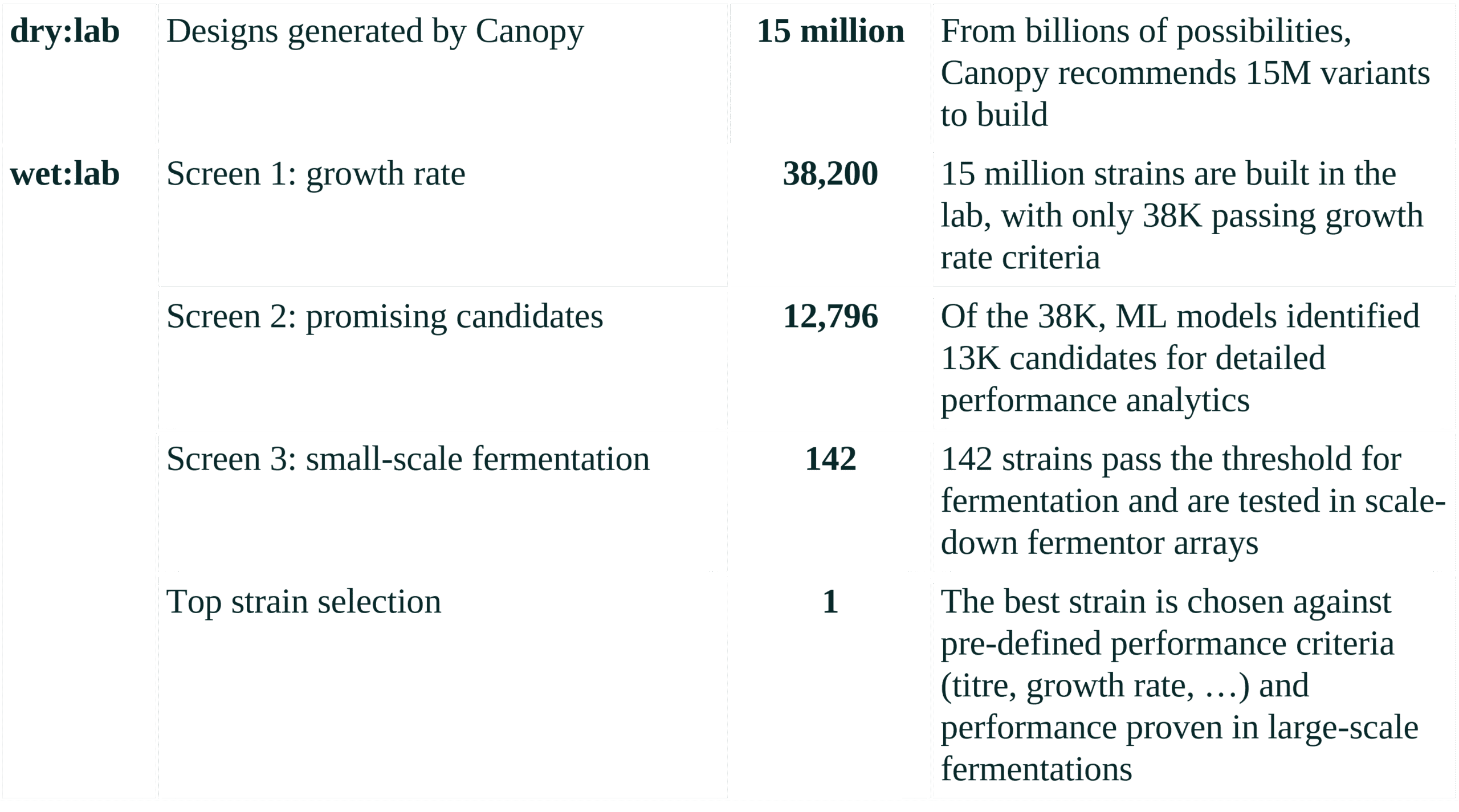
Canopy was used to explore the biological design space prior to experimentation, combining pathway reasoning, enzyme selection, host optimisation and strain engineering predictions.
Results
The highest-performing strain achieved:
- The top strain achieved 3.1 g/L fermentation titre in a 5L fed-batch fermentation
- Highest reported in literature for similar products are 2.266 – 2.43 g/L, representing more than 130% increase g/g and 260% increase mol:mol.
- Fully stabilised strain, capable of continuous fermentation, successfully scaled to 20 L
- Successful optimisation of a five-gene biosynthetic pathway
- Production of a patented cosmetic active directly from central carbon metabolism
Impact
Rather than relying on random library construction, Canopy reduced an enormous combinatorial search problem into an experimentally tractable set of candidates with a high probability of success.
This programme demonstrates how AI-guided strain design can achieve state-of-the-art biological performance while substantially reducing laboratory iteration.